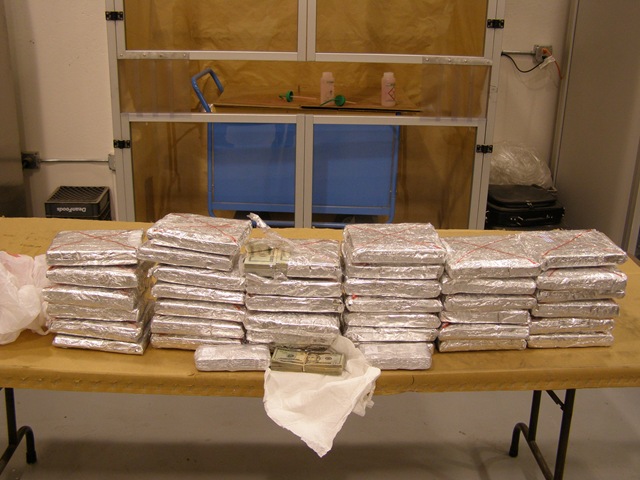
U.S. Currency confiscated in traffic stop by El Paso County Sheriff’s Office.
Back in January of this year the El Paso Journal reported that an El Paso County sheriff's deputy pulled over a Freightliner Tractor Trailer on Friday Aug 18, 2008 at I-10 mile marker 45 in the eastern part of EL Paso county. While conducting a search of the trailer he discovered about $1 million in cash.
The sheriff's dept claims a deputy pulled the tractor-trailer over at about 2:48 p.m. After noticing the vehicle was "weaving in and out of traffic," sheriff's spokesman Rick Glancey said. The deputy requested backup after noticing that the driver of the tractor-trailer was acting suspicious. Another deputy with a police dog responded to the scene, and allegedly the dog alerted the deputies to cash inside the rig.
The report then states that while examining the tractor-trailer's cargo, deputies discovered several bundles of cash. Detectives from the El Paso County Sheriff’s office - Special Operations Division were summoned to the scene. Based on size and weight Detectives estimate a-million dollars in cash was confiscated.
An investigation into the discovery of the undeclared cash continues at this time it is believed. A source close to the investigation reports detectives are believed to be investigating where the large amount of cash came from. They are looking into the possibility that the money could be related to illegal drugs and/or terrorist activity.
To date no new information or even basic details have been released by the El Paso County Sheriff's Department. The El Paso Journal has requested additional info on the matter and there has been no response from the Sheriff's office. They will not give the media the suspect’s name, age or if he has been charged and if so what the charge or charges are. This clandestine profile the Sheriff has adopted and the lack of cooperation is highly unusual.
The Sheriff's office did admit by saying," this is a major case and an ongoing investigation is still underway by the Special Operations Division. The identity is still being withheld and it is unknown at this time if any charges will be filed against the driver. It is possible the suspect has secretly been charged and the information withheld from the public which if true that would be in violation of the U.S. Constitution.
An area law enforcement officer has told the El Paso Journal that the investigation is being handled the way that it is because bulk cash smuggling from the United States to Mexico has increased dramatically. According to the fedsthis is most likely the result of enhanced U.S. anti-money laundering (AML) regulations and law enforcement actions, which have made it more difficult for drug traffickers to launder drug proceeds through many U.S. financial institutions. And many of the Mexican drug cartels are suspected of moving the illegal drug money in varies vehicles including tractor trailers.
It is believed that bulk cash smuggling is now the primary technique used by Mexican Click on or Google: Drug Trafficking Organizations (DTOs) also known as Mexican Drug Cartels (MDC's). We'll use DTO's for this report.
Typically, bulk cash is transported by Mexican DTOs to consolidation points throughout the United States and transported over U.S. Highways to the Southwest Border.
According to the U.S. Border Patrol the consolidation points are often major metropolitan areas, or border cities like El Paso, or larger drug markets such as Dallas, Atlanta, Charlotte (NC), Chicago, Denver, Detroit, Miami, San Diego, and New York. For example, law enforcement officials in Chicago estimate that between $10 million and $24 million in bulk cash drug proceeds are moved from that city each month, destined for Southwest Border locations. Additionally, law enforcement agencies have made several large bulk currency seizures from passengers traveling from U.S. drug markets dominated by Mexican DTOs to Southwest Border areas on Mexican bus lines. A number of Mexican bus lines operate daily service between Mexico, Southwest Border states, and many of the known bulk cash consolidation points used by Mexican traffickers.
New U.S. Government regulations and law enforcement actions, seems to have made it increasingly difficult for drug traffickers to place illicit proceeds directly into U.S. banks and other financial institutions. Therefore these actions are believed to have resulted in most Mexican Asian and Colombian DTOs avoiding such money laundering methods. Instead, Mexican Asian and Colombian DTOs transport illicit drug proceeds (cash) from U.S. drug markets to other U.S. locations for consolidation. The proceeds often are transported in bulk to an area near the U.S.-Mexico border and are either smuggled into Mexico at Southwest Border ports of entry (POEs), primarily in South Texas, or remitted electronically to Southwest Border locations, where the transferred cash is then smuggled across the U.S.-Mexico border.
Diversification is a vital component of drug money laundering operations in the United States. The majority of DTOs operating in the United States--including launderers working for Mexican, Asian and Colombian DTOs that are responsible for most wholesale-level drug trafficking--rely on multiple methods to move and launder illicit proceeds. Law enforcement investigations initiated since January 2006 indicate that most DTOs use two or more techniques to launder drug proceeds. Even in Southwest Border states, where bulk cash smuggling is the predominant method of moving drug proceeds, most organizations use a variety of drug money laundering techniques, including wire remittances through Money services businesses (MSBs) which have become a critical component to the ability of DTOs to launder illicit drug proceeds. They also buy and sell businesses and use them as front companies, who export and import into the U.S. They also buy and sell real estate properties, Then structure deposits in traditional bank deposits. They try to structure their deposits in unusually small amounts as a money laundering technique.
Emerging technology is equipping DTOs with novel money laundering idea’s and techniques. The cash is deposited into Mexican banks and other financial institutions with just a portions of the money electronically wire-transferred to the United States and other Latin American countries for placement into their financial systems. Other countries, such as Panama, Korea, China, Taiwan, and Hong Kong, is used to facilitate the Black Market Peso Exchange (BMPE) The cash is repatriated to the United States by Mexican financial institutions for reintroduction into the U.S. financial system. Then some of the remaining cash is smuggled in bulk farther south to Guatemala, Panama, Colombia, or other Latin American countries. Some of the cash is also used by the Mexico DTO’s (Mexican drug cartels) for operational expenses.
Money Services Businesses (MSBs) have become a critical component to the ability of DTOs to launder illicit drug proceeds. Many DTOs use U.S.-based MSBs--particularly money transmittal and check-cashing businesses to launder drug proceeds, frequently in conjunction with bulk cash smuggling. The diversity of services offered at many MSBs accommodates launderers' needs. Mexican DTOs often wire illicit proceeds in structured amounts through MSBs to collection points in Southwest Border states, where the wires are cashed, and most of the money is then smuggled across the border. In some cases, DTOs wire money directly to Mexico. Law enforcement reporting reveals that Mexico is the primary destination for suspicious funds sent through MSBs; however, law enforcement officials also report that significant amounts of money are also sent through MSBs to Colombia, the Dominican Republic, Russia, and various locations in Central America and South America. Money orders purchased at MSBs and U.S. Post Offices are also commonly used by drug traffickers to launder money. A review of OCDETF case initiations indicates that approximately 20 percent of its newly initiated money laundering investigations contain a money order component. Law enforcement officials, especially those from U.S. Immigration and Customs Enforcement (ICE) and DEA and the regulatory community, have noted the continuous movement of money orders to Mexico and other Latin American countries in money laundering schemes. Additionally, open-system prepaid cards, also a product provided by MSBs, are used by drug money launderers. These cards can effectively be used to remit money across borders because card value can be added or withdrawn at automated teller machines (ATMs) worldwide.
Many DTOs exploit traditional depository institutions, sometimes innovatively. Traffickers exploit the services provided by traditional depository institutions to launder significant amounts of illicit drug proceeds, despite provisions in the USA PATRIOT Act Click on or Google: The Patriot Act And You! that tightened AML programs for such institutions. According to Financial Crimes Enforcement Network (FinCEN) reporting, Suspicious Activity Report (SAR) filings for Bank Secrecy Act (BSA)/Structuring/Money Laundering continue to be high (302,818 filings in 2006) and remain the leading violation type by far of all suspicious activity reported by depository institutions. In addition to structuring, DTOs, primarily Colombian and Mexican, move illicit drug proceeds by depositing money in U.S. bank accounts and then quickly withdrawing the money from ATMs located in other states or countries; they also move these funds by wire transfer. Additionally, DTOs use correspondent, "payable through," and nested accounts to covertly access the U.S. financial system and move money within the United States and throughout the world.
About the Author
America's leading authority on Venture Capital/Equity Funding. A trustee on some of the nations largest trade Union funds. A noted Author, Lecturer, Educator, Emergency Manager, Counter-Terrorist, War on Drugs and War on Terrorist Specialist, Business Consultant, Newspaper Publisher. Radio News caster. Labor Law generalist, Teamster Union Business Agent, General Organizer, Union Rank and File Member Grievances Representative, NLRB Union Representative, Union Contract Negotiator, Workers Compensation Appeals Board Hearing Representative. Investigative Reporter for print, electronic and on-line News Agencies.
Boxer - Dog Training Charlotte NC The Dog Wizard
[simpleaffiliate source="amazon" results="10"]dog training charlotte nc[/simpleaffiliate] [simpleaffiliate source="clickbank" results="5"]dog training charlotte nc[/simpleaffiliate]
Rewards can be praise, treats, play, or anything that the dog finds rewarding. Reward or praise your dog for a good performance. It has been shown in animal behavioral science and among most trainers that dogs and other animals work better for reward than out of fear of the handler.
If the handler sometimes says "good" as a reward marker and sometimes as a keep going signal, it is difficult for the dog to know when he has earned a reward. It is important to note that the dog's reward is not the same as the reward marker. The reward marker is a signal that tells the dog that he has earned the reward. Many novice dog owners make the mistake of using effusive verbal praise as both a reward marker and a reward, which can confuse dog and owner. Failure to reward after the reward marker diminishes the value of the reward marker and makes training more difficult. In particular, mechanical clickers are frequently used for the reward marker. "Positive training methods" generally means preferring the use of reward-based training to increase good behavior over that of physical punishment to decrease bad behavior. The more rewarding a dog finds a particular reinforcer, the more work he will be prepared to do in order to obtain the reinforcer.
Dogs do not figure out basic obedience on their own; they must be trained. Dogs that are handled and petted by humans regularly during the first eight weeks of life are generally much more amenable to being trained and living in human households. Note that not all dogs are trained to voice command. Many working breeds of dog are not trained to a voice command at all; they are taught to obey a combination of whistles and hand signals. Dogs are also trained for specific purposes, including: Detection dogs, Assistance dogs, Herding dogs, livestock guardian dogs, and sheep dogs hunting dogs, Police dogs, Rescue dog,s Schutzhund German for "protection dog".
A well-trained guard dog protects person, property or objects on command and "turns-off" on command as well. Properly trained animals will guard on command and then when commanded to "out" will approach and accept in a friendly manner those that may have attempted to gain entry, cause harm or steal protected items. Assistance dogs, such as guide and hearing dogs, are carefully trained to utilize both their sensory skills and the protective instincts of dogs (as pack animals) to bond with a human and help that person to offset a disability in daily life. A trained dog is a content, balanced and happy dog. ) However, it does show what dogs are capable of, and this includes all dogs, hence the reason we believe all dogs should be trained in basic emergency stop and down commands, which even these dogs don't seem to know too well.
Once your dog is well trained you will find that you involve him in the family events more often and this alone will mean more exercise and better health for your dog. Bottom line is that a properly exercised and trained dog will bring you and your family more pleasure and for more years.
Remote Shock Collars are one of the most effective, easiest and most humane training aids available. Remote Shock Collars are placed on a dog's neck, allowing a trainer to deliver small static corrections of varying strength by remote control. The correction the dog gets from the remote dog training collar is no different than static from walking on carpet. The benefits of working with a remote dog training collar is the trainer can immediately correct a dog's mistakes at a distance far greater than leash training allows. A Shock Collar is a safe, effective and humane way to train your dog.
[simpleaffiliate source="amazon" results="10"]schutzhund dog training[/simpleaffiliate] [simpleaffiliate source="clickbank" results="5"]schutzhund dog training[/simpleaffiliate]
Schutzhund Dog Training Is Not So Difficult - Read These Top Tips
Many folks just don't have the time to train their dogs the way they wish to, and if this will be the case then utilizing electronic dog training collars could be your only hope. The other side of this is if your dog is simply out of control, you've tried everything you are able to and absolutely nothing has seemed to work.
Before acquiring started, it really is very essential to make use of dog training collars in a responsible manner. If not utilised properly you could potentially cause harm to your family pet and this would be the complete opposite of what you are attempting to obtain. You can find several different varieties of training collars such as, bark shock collars, wireless dog training collars, and electronic training collars. These collars are not to be confused because when training your dog, you want the correct collar for the right job. In this post we will discuss three advantages from using electronic dog training collars.
1.) Acquiring your dogs aggression under control.
Some of you that have aggressive dogs received them that way via no fault of your own. If a dog is left untrained with an aggressive behavior they are merely unpredictable and could possibly harm you, a friend or a neighbor. Since they are aggressive they require to learn this just isn't acceptable, and a really fast way to obtain this is by using wireless training collars. Employing the training methods that can come with your device will help you get that aggressive behavior under control.
2.) Control your dogs barking.
Many dogs adore to bark and occasionally they bark uncontrollably. When this occurs, you could have potential difficulties with buddies or neighbors and in some circumstances have the local authorities called for the issue. Training for this occurs when the dog is wearing the proper collar and he starts to bark. The barking sound will trigger the collar immediately and the dog will receive a slight shock. Now this training does not call for you to even be at house. This occurs each and every single time they choose they wish to be a nuisance.
three.) Quit your dog from jumping on individuals.
Several individuals have problems with their dogs jumping up on them or other individuals. This is downright embarrassing. This can all be brought under control and you don't need anything other than wireless dog training collars. Whenever your dog decides to jump, send them a signal that this type of behavior isn't acceptable. This may eventually break your pet from this terrible habit and restore peace and serenity to the household. Dogs that jump on men and women will continue to do so until they learn this is not the appropriate method to greet somebody.
The positive aspects listed above will help you inside your training efforts to maintain a balance between an uncontrollable dog and an obedient 1. Use your dog training collar wisely and you are going to see gratifying results.
There actually is no secret to dog training.
Let me repeat and complete that comment.
There really is no secret to dog training as soon as you read it.
Like the over 216,000 readers of this program, I've had my share of dogs with bad habits. At the time, I didn't relate the problem as me being the trigger except when my pet actually did something proper, and then I was a great trainer. When my pet did not listen, it was the dog's bad habit.
I think back over the dogs I've had in my life, along with the list is lengthy.
About the Author
I adore animals and pets. Right now i write mostly about pet dogs and the best way to train them. For a lot much more info about this, please pay a visit to my web site. Thanks
<a href="http://www.dogtrainingaid.net/">Dog Training Aids</a>
[simpleaffiliate source="chitika" results="0"][/simpleaffiliate] Dog Tracking help for an English Springer Spaniel?
My dog just turned 1 years old. He is an english springer spaniel and I would like to train him to track. I have no experience in this at all. I need advise and directions. and What kind of supplies do you think I need? and how much on and average is this going to cost? Thank you for your help -Jen I live in MA. and can you send me a link of the yahoo group on tracking? thanks
WHAT IS A PERSONAL INJURY CASE IN ORANGE COUNTY CALIFORNIA?
By Orange County personal injury and wrongful death lawyer, Jon Mitchell Jackson (2009 Trial Lawyer of the Year) at http://jacksonandwilson.com
A personal injury or catastrophic injury case occurs when a person has suffered some form of severe physical or psychological injury as a result of another person or company’s wrongful conduct. The wrongful conduct may be simple negligence or intentional, willful, wanton or reckless conduct.
In some instances, a party may be strictly liable for injury to another without the injured person having to show any wrongdoing by the other party.
Personal injury cases we've helped families with over the past 25 years include the following...
Automobile Accident Injuries- Each year in the United States there are more than six million motor vehicle accidents. This year, approximately 10,839 people will die in drunk-driving crashes – one every 50 minutes.
Motorcycle Accident Injuries- Each year, about 4,000 riders sustain fatal injuries in motorcycle accidents. And each year, another 76,000 are injured. Statistically, about 12 motorcycle riders are involved in fatal accidents each day with another 208 riders sustaining injury on U.S. roadways.
Large Truck Accident Injuries- On an annual basis, there are about 5,000 large truck related fatal accidents in the United States.
Slip and Fall Injuries- Most people are not aware of the fact that slip and fall injuries are the second leading cause of injuries in the United States. On an average, they account for about 16,000 deaths every year.
Dog Bite Injuries- Each year across the United States, almost 5,000,000 people are bitten or attacked by dogs and 334,000 dog bite and dog attack victims require emergency medical treatment.
Spinal Cord and Paralysis Injuries- Every year, about 11,000 Americans experience spinal cord injuries, adding up to 200,000 people living with spinal cord injury disability in the United States.
Burn Injuries- Each year in the United States, about 4,500 people die from severe burn injuries. Another 45,000 people are hospitalized. Up to 10,000 people in the United States die each year of burn-related infections. When you look at the total numbers, more than 1.1 million of our citizens experience some type of burn injury each and every year.
Head and Brain Injuries- About 1,000,000 Americans experience major head and brain injuries each year.
Drowning- For any given year, there is one drowning of a child for every 11,000 residential pools in the United States. What this means is that in a country with 6 million pools, roughly 550 children under the age of ten drown each year.
Medical Malpractice- It is conservatively estimated that about 90,000 people lose their lives annually in the hospital because of medical malpractice. Medication errors affect almost 1.5 million people each year.
Other personal injury cases we've helped clients with include animal attacks, boat and watercraft accidents, brain injuries, construction accidents, hazardous products, insurance bad faith cases, medical malpractice, product liability, professional malpractice, railroad accidents, and wrongful death cases.
What Damages are Available in a California Personal Injury Case?
In most catastrophic personal injury cases, a victim may be entitled to monetary compensation for bodily injury and pain and suffering from the person or company whose negligent or wrongful conduct caused the injury. This includes a momentary lapse in judgment, a mistake or simple negligence.
Injuries caused by intentional, willful, wanton or reckless conduct may also allow an injured party to receive punitive damages which are designed to punish the responsible party. Over the past two decades, we've handled both types of case.
The primary damages you may be entitled to if you are a victim of personal injury are called compensatory or actual damages. These damages are intended to provide reimbursement or payment to you for your past and future "out of pocket" expenses or losses. Please keep in mind that an expert is normally required to help prove the full extent of your recoverable damages.
The most common compensatory damages include the following:
Medical Expenses- Past and future bills and expenses for health care services from an ambulance or emergency providers, hospitals, doctors, medication, and related services from nurses or other health care providers related to your injury, care and treatment.
Lost Earnings- If you were unable to work for a period of time after the incident, you are entitled to recover reimbursement of all lost wages.
Impaired Earning Capacity- Any reduction of your ability to earn a living (can't do the same job anymore) is recoverable. In many instances, an expert economist is retained to help determine what the actual loss of income is.
Future Medical Expenses- All reasonably necessary future medical care and treatment is recoverable. Again, this is normally proven with the help of experts.
Pain and Suffering- These damages are awarded to compensate an injury victim for all past and future pain and suffering related to the incident and injury.
Mental Anguish- Personal injury victims who have sustained extreme mental or emotional suffering or distress are entitled to compensation. In some cases, this may also include someone who has witnessed the severe injury or death of a loved one.
Loss of Consortium- If, because of a personal injury, the victim's spouse is unable to enjoy the benefits of marriage (companionship, affection, comfort, or sexual relations), a claim for monetary damages may be sought. Please note that these claims will normally "open the door" to many privacy issues.
Loss of Society and Companionship- In wrongful death cases, these damages are awarded to an heir for the loss of love, comfort, and companionship.
Property Damage- Any property damage to a vehicle or personal items may be recovered by the victim in a personal injury case.
What is the Standard of Proof in a California Personal Injury Case?
The standard of proof in the United States is typically preponderance of the evidence as opposed to clear and convincing or beyond a reasonable doubt. Because proving a case beyond a preponderance of the evidence (slight tipping of scales) is usually easier than a criminal prosecution (beyond a reasonable doubt), most personal injury cases are handled in the civil court system.
Are There Any Special Time Limits to Asserting a California Personal Injury Case?
Yes there are. Time is of the essence in many personal injury actions. In civil personal injury cases, most states have a strict statute of limitations which means that court proceedings must be properly commenced within a certain period of time after the incident or the victim will lose his or her right to bring a claim.
Other time sensitive issues and areas of possible concern involve preserving evidence and identifying defendants, insurance coverage and assets. This normally requires retaining investigators and experts to commence investigations and evaluations as promptly as possible. In fact, our office has a checklist of more than 140 items that we review in every new case that comes in to our office.
For these reasons alone, most personal injury victims agree that hiring an experienced California personal injury lawyer should not be delayed.
Can a Person Who Causes Harm to Another Human Being be Prosecuted for Both the Criminal Harm and the Civil Personal Injury?
The answer is yes. In some instances, a civil and criminal case can both be filed at the same time. People are routinely charged with the crimes of assault, battery, attempted murder and even murder. False imprisonment and fraud are other crimes that sometimes involve civil rights too.
In these cases, we work with the District Attorney's Office to coordinate their prosecution of the crime with our handling of the civil personal injury case.
From a Lawyers Perspective, What Does it Take to Be a Good Personal Injury Lawyer?
Well, first of all it takes many years and many cases before a lawyer "learns" how to properly handle and persuasively argue a personal injury case. By their very nature, the available damages in a personal injury case are not always quantifiable through formulas or expert testimony.
The extent of compensation a personal injury victim may be entitled to recover is normally related to the preparation and artfulness of the lawyers who are retained to help them. Convincing insurance companies and jurors to award all reasonable and necessary damages takes practice and experience. The ultimate amount recovered is normally directly related to the attorney's skills of persuasion and advocacy.
What Happens Next in a Personal Injury Case?
When you or a family member is involved in a personal injury , it’s extremely important to act quickly and make smart decisions from the very beginning of your case.
Being seen and properly diagnosed by an experienced and well respected health care provider shortly after your accident or injury is important for two reasons. First, making sure you get proper medical treatment is important to your short and long-term recovery. Second, it’s absolutely necessary in personal injury cases to have your doctors properly document (medical records, reports, photographs, x-rays, CT/MRI scans…) all of your injuries and treatment. This record or history will be used to confirm all of your injuries and injury related issues later in the claim, litigation, or trial process.
Doctors such as orthopedic surgeons, neurologists, physical therapists and chiropractors may be needed to help you recover as fast as possible. Economists, life-case planners, as well as experts in vocational rehab are sometimes necessary to help calculate, explain and prove your financial losses.
Investigation and Protecting Evidence
When it comes to investigating the incident that caused your injuries and damages, it’s important to keep in mind that evidence can be difficult to locate as time passes. Objects get moved or removed from the accident scene. Skid marks wash away with rain and other evidence such as broken asphalt, walls, and buildings get repaired or replaced. Damage to vehicles may get repaired before being photographed and the memories of defendants and witnesses fade over time (or after being coached by the other side). In some cases these people simply “disappear.”
To avoid having this happen to you, photographs and video should be taken and all evidence preserved. Investigators should be used to talk to and record the statements of the people involved in your incident and to interview all witnesses.
In most cases, experts in areas such as accident reconstruction or bio-mechanical engineering should be retained and used to review the facts and help establish liability, force of impact, and damages in your case.
Claim and Lawsuit Filing Deadlines
In almost every case, you only have a certain period of time to file a claim or lawsuit. If you fail to properly file or serve the required legal documents in a timely fashion, you will forever lose your legal right to pursue a claim or case against the responsible party. The requirements and time period you have to file a claim against a governmental entity such as a city, county or state is different than when dealing with a private party or company in a slip and fall or automobile, motorcycle, or large truck accident case. Medical malpractice cases also have their own unique requirements and limited time periods to take action.
Legal Documents
Legal documents called claims, pleadings, and motions are normally prepared to file with the court to protect your rights and maximize your chances of obtaining a full and complete settlement or verdict. Settlement demand packages are also sometimes necessary to attempt settlement of a case before the need for a lawsuit becomes necessary. Mediation, arbitration and trials are all used to obtain a final decision in a personal injury and wrongful death case.
Who Pays in a Personal Injury Case?
When it comes to recovering damages in most vehicle accident cases, most experienced personal injury law firms look to the responsible party’s automobile liability insurance or homeowners insurance. If the person who caused your injuries was employed with a company at the time he or she caused the accident and, was in the scope and course of employment, we may also pursue a claim against the employer company based upon a legal theory of respondent superior (the employer is liable for the wrongful conduct of its employees while on the job).
Other theories of liability may also be reviewed and pursued which might include a dangerous or defective product claim against the manufacturer or a maker of one of the vehicles parts or components (defective brakes, tires, unsafe/exploding gas tank design…).
If the other party has insufficient insurance or no insurance at all, you may be entitled to bring an uninsured motorist or underinsured motorist claim available against your own insurance company. In these circumstances, we will also use experts to undertake an asset background check to see whether or not there is any real property, bank accounts, home equity, or other significant assets to cover your losses. In many cases where the other party was either uninsured or insufficiently insured, we’ve been able to use these techniques to get payment on a large judgment against the other side.
The bottom line is that no settlement should take place and no settlement releases should be signed until you have full and complete answers to all of the above questions and issues.
Get Your Questions Answered Today!
Since 1986, we’ve truly enjoyed helping people, not big corporations and insurance companies. Our daily focus involves protecting the injured, the wronged, and the voiceless, not large businesses that routinely trample, abuse, and exploit the rights of the less fortunate.
Our drive and motivation has always been devoted to leveling the playing field for our clients and families against the self-serving goals of corporate greed and higher corporate profits.
We truly look forward to answering any questions you may have about your personal injury or wrongful death case. Give us a call or visit our web site for more help and information.
More information, case results, and testimonials can be found at the firm’s web site at www.JACKSONandWILSON.com or also go to http://jacksonandwilson.com
Also feel free to call with your legal questions or needs: 800-661-7044
Copyright 2011 Jackson & Wilson, Inc.
More About Orange County, California
Many of our clients ask us about Orange County. They want to know our history and many of our friends on the other side of the world would like some reference to exactly where we're located in California.
Well, in an effort to answer all of your questions, here you go...
Orange County is a county in California. Its county seat is Santa Ana. As of the 2000 census, its population was 2,846,293, while a July 2008 estimate placed the population at 3,010,759, making it the second most populous county in California, behind Los Angeles County and ahead of San Diego County.
It is the sixth most populous county in the United States as of 2009 while at the same time is also the smallest area-wise county in Southern California, being roughly half the size of the next smallest county, Ventura. The county is famous for its tourism, as the home of such attractions as Disneyland and Knott's Berry Farm, as well as several beaches along its more than 40 miles (64 km) of coastline. It is also known for its affluence and political conservatism. In fact, a 2005 academic study listed three Orange County cities as being among America's 25 "most conservative," making it the only county in the country containing more than one such city.
Orange County also became well known for being the largest US county ever to have gone bankrupt, when in 1994, longtime treasurer Robert Citron's investment strategies left the county with inadequate capital to allow for any raise in interest rates for its trading positions. When the conservative residents of Orange County voted down a proposal to raise taxes in order to balance the budget, bankruptcy followed shortly thereafter. Citron later pleaded guilty to six felonies regarding the matter.
Whereas most population centers in the United States tend to be identified by a major city, there is no defined urban center in Orange County. It is mostly suburban, except for some traditionally urban areas at the centers of the older cities of Anaheim, Santa Ana, Orange, Huntington Beach, and Fullerton. There are also several edge city-style developments such as South Coast Metro and Newport Center.
While Santa Ana serves as the governmental center of the county, Anaheim is its main tourist destination, and Irvine its major business and financial hub. Four Orange County cities have populations exceeding 200,000: Santa Ana, Anaheim, Irvine, and Huntington Beach.
Thirty-four incorporated cities are located in Orange County; the newest is Aliso Viejo, which was incorporated in 2001. Anaheim was the first city incorporated in Orange County, in 1870 when the region was still part of neighboring Los Angeles County.
Members of the Tongva, Juaneño, and Luiseño Native American groups long inhabited the area. After the 1769 expedition of Gaspar de Portolà, a Spanish expedition led by Junipero Serra named the area Valle de Santa Ana (Valley of Saint Anne). On November 1, 1776, Mission San Juan Capistrano became the area's first permanent European settlement. Among those who came with Portolá were José Manuel Nieto and José Antonio Yorba. Both these men were given land grants - Rancho Los Nietos and Rancho Santiago de Santa Ana, respectively. The Nieto heirs were granted land in 1834. The Nieto ranches were known as Rancho Los Alamitos, Rancho Las Bolsas, and Rancho Los Coyotes. Yorba heirs Bernardo Yorba and Teodosio Yorba were also granted Rancho Cañón de Santa Ana (Santa Ana Canyon Ranch) and Rancho Lomas de Santiago, respectively. Other ranchos in Orange County were granted by the Mexican government during the Mexican period in Alta California.
A severe drought in the 1860s devastated the prevailing industry, cattle ranching, and much land came into the possession of Richard O'Neill, Sr., James Irvine and other land barons. In 1887, silver was discovered in the Santa Ana Mountains, attracting settlers via the Santa Fe and Southern Pacific Railroads.
This growth led the California legislature to divide Los Angeles County and create Orange County as a separate political entity on March 11, 1889. The county is generally said to have been named for the citrus fruit (its most famous product). However, in the new county there was already a town by the name of Orange, named for Orange County, Virginia, which itself took its name from William of Orange. The fact the county took the same name as one of its towns may have been coincidence.
Other citrus crops, avocados, and oil extraction were also important to the early economy. Orange County benefited from the July 4, 1904 completion of the Pacific Electric Railway, a trolley connecting Los Angeles with Santa Ana and Newport Beach . The link made Orange County an accessible weekend retreat for celebrities of early Hollywood. It was deemed so significant that the city of Pacific City changed its name to Huntington Beach in honor of Henry Huntington, president of the Pacific Electric and nephew of Collis Huntington. Transportation further improved with the completion of the State Route and U.S. Route 101 (now mostly Interstate 5) in the 1920s.
South Coast Metro area in central Orange County- Agriculture, such as the boysenberry which was made famous by Buena Park native Walter Knott, began to decline after World War II but the county's prosperity soared. The completion of Interstate 5 in 1954 helped make Orange County a bedroom community for many who moved to Southern California to work in aerospace and manufacturing. Orange County received a further boost in 1955 with the opening of Disneyland.
In 1969, Yorba Linda-born Orange County native Richard Nixon became the 37th President of the United States.
In the 1980s, the population topped two million for the first time; Orange County had become the second-most populous county in California.
An investment fund melt-down in 1994 led to the criminal prosecution of County of Orange treasurer Robert Citron. The county lost at least $1.5 billion through high-risk investments in derivatives. On December 6, 1994, the County of Orange declared Chapter 9 bankruptcy, from which it emerged in June 1995. The Orange County bankruptcy was the largest municipal bankruptcy in U.S. history.
In recent years land-use conflicts have arisen between established areas in the north and less developed areas in the south. These conflicts have regarded things such as construction of new toll roads and the re-purposing of a decommissioned air base. For example, the El Toro Marine Corps Air Station site was designated by a voter measure in 1994 to be developed into an international airport to alleviate the heavily used John Wayne Airport. But subsequent voter initiatives and court actions have caused the airport plan to be permanently shelved. Instead it will become the Orange County Great Park.
Geography- According to the U.S. Census Bureau, the county has a total area of 2,455 km2 (948 sq mi), making it the smallest county in Southern California. Surface water accounts for 411 km2 (159 sq mi) of the area, 16.73% of the total; 2,044 km2 (789 sq mi) are land. The average annual temperature is about 68 °F (20 °C). Despite its small size as a county, Orange County's total area in square miles is actually just smaller than the State of Rhode Island's land area.
Orange County is bordered on the southwest by the Pacific Ocean, on the north by Los Angeles County, on the northeast by San Bernardino County and Riverside County, and on the southeast by San Diego County.
View of the Santa Ana Mountains from Newport Harbor- The northwestern part of the county lies on the coastal plain of the Los Angeles Basin, while the southeastern end rises into the foothills of the Santa Ana Mountains. Most of Orange County's population reside in one of two shallow coastal valleys that lie in the basin, the Santa Ana Valley and the Saddleback Valley. The Santa Ana Mountains lie within the eastern boundaries of the county and of the Cleveland National Forest. The high point is Santiago Peak (5,689 feet (1,734 m)[10]), about 20 mi (32 km) east of Santa Ana. Santiago Peak and nearby Modjeska Peak, just 200 feet (60 m) shorter, form a ridge known as Saddleback, visible from almost everywhere in the county. The Peralta Hills extend westward from the Santa Ana Mountains through the communities of Anaheim Hills, Orange, and ending in Olive. The Loma Ridge is another prominent feature, running parallel to the Santa Ana Mountains through the central part of the county, separated from the taller mountains to the east by Santiago Canyon.
The Santa Ana River is the county's principal watercourse, flowing through the middle of the county from northeast to southwest. Its major tributary to the south and east is Santiago Creek. Other watercourses within the county include Aliso Creek, San Juan Creek, and Horsethief Creek. In the North, the San Gabriel River also briefly crosses into Orange County and exits into the Pacific on the Los Angeles-Orange County line between the cities of Long Beach and Seal Beach. Laguna Beach is home to the county's only natural lakes, Laguna Lakes, which are formed by water rising up against an underground fault.
Residents sometimes figuratively divide the county into "North Orange County" and "South County" (meaning Northwest and Southeast—following the county's natural diagonal orientation along the local coastline). This is more of a cultural and demographic distinction perpetuated by the popular television shows "The OC" and "Laguna Beach", between the older areas closer to Los Angeles, and the more affluent and recently developed areas to the South and East.
A transition between older and newer development may be considered to exist roughly parallel to State Route 55 (aka the Costa Mesa Freeway). This transition is accentuated by large flanking tracts of sparsely developed area occupied until recent years by agriculture and military airfields.
While there is a natural topographical Northeast-to-Southwest transition from inland elevations to the lower coastal band, there is no formal geographical division between North and South County. Perpendicular to that gradient, the Santa Ana River roughly divides the county between northwestern and southeastern sectors (about 40% to 60% respectively, by area), but does not represent any apparent economic, political or cultural differences, nor does it significantly affect distribution of travel, housing, commerce, industry or agriculture from one side to the other.
Incorporated cities- As of August 2006, Orange County has 34 incorporated cities. The oldest is Anaheim (1870) and the newest is Aliso Viejo (2001).
Aliso Viejo, incorporated in 2001
Anaheim, incorporated in 1870
Brea, incorporated in 1917
Buena Park, incorporated in 1953
Costa Mesa, incorporated in 1953
Cypress, incorporated in 1956
Dana Point, incorporated in 1989
Fountain Valley, incorporated in 1953
Fullerton, incorporated in 1904
Garden Grove, incorporated in 1956
Huntington Beach, incorporated in 1909
Irvine, incorporated in 1971
La Habra, incorporated in 1925
La Palma, incorporated in 1955
Laguna Beach, incorporated in 1927
Laguna Hills, incorporated in 1991
Laguna Niguel, incorporated in 1989
Laguna Woods, incorporated in 1999
Lake Forest, incorporated in 1991
Los Alamitos, incorporated in 1960
Mission Viejo, incorporated in 1988
Newport Beach, incorporated in 1906
Orange, incorporated in 1888
Placentia, incorporated in 1926
Rancho Santa Margarita, incorporated in 2000
San Clemente, incorporated in 1928
San Juan Capistrano, incorporated in 1961
Santa Ana, incorporated in 1886
Seal Beach, incorporated in 1915
Stanton, incorporated in 1956
Tustin, incorporated in 1927
Villa Park, incorporated in 1962
Westminster, incorporated in 1957
Yorba Linda, incorporated in 1967
Unincorporated communities- These communities are outside of city limits in unincorporated county territory:
Coto de Caza
Cowan Heights
El Modena
Emerald Bay
Foothill Ranch
Ladera Ranch
Lemon Heights
Midway City
Modjeska Canyon
North Tustin
Orange Park Acres
Rancho Mission Viejo
Red Hill
Rossmoor
Silverado Canyon
Sunset Beach
Trabuco Canyon
Planned communities- Orange County has a history of large planned communities. Nearly 30% of the county was created as master planned communities[citation needed], the most notable being the City of Irvine, Coto de Caza, Anaheim Hills, Tustin Ranch, Tustin Legacy, Ladera Ranch, Talega, Rancho Santa Margarita, and Mission Viejo. Irvine is often referred to as a model master-planned city, for its villages of Woodbridge, Northwood, University Park, and Turtle Rock that were laid out by the Irvine Company of the mid-1960s, pre- Donald Bren.
Adjacent counties- Los Angeles County, California - north, west; San Bernardino County, California - northeast; Riverside County, California - east; San Diego County, California - southeast; Los Angeles County San Bernardino County; Los Angeles County Riverside County
Orange County, California; San Diego County
National protected areas- Cleveland National Forest (part); Seal Beach National Wildlife Refuge
Transportation infrastructure- Transit in Orange County is offered primarily by the Orange County Transportation Authority. The American Public Transportation Association (APTA) cited OCTA as the best large property transportation system in the United States for 2005. OCTA manages the county's bus network and funds the construction and maintenance of local streets, highways, and freeways; regulates taxicab services; maintains express toll lanes through the median of California State Route 91; and works with Southern California's Metrolink to provide commuter rail service along three lines - the Orange County Line, the 91 Line, and the Inland Empire-Orange County Line.
Major highways- Surface transportation in Orange County relies heavily on three major interstate highways: the Santa Ana Freeway (I-5), the San Diego Freeway (I-405 and I-5 south of Irvine), and the San Gabriel River Freeway (I-605), which only briefly enters Orange County territory in the northwest. The other freeways in the county are state highways, and include the perpetually congested Riverside and Artesia Freeway (SR 91) and the Garden Grove Freeway (SR 22) running east-west, and the Orange Freeway (SR 57), the Costa Mesa Freeway (SR/SR 55), the Laguna Freeway (SR 133), the San Joaquin Transportation Corridor (SR 73), the Eastern Transportation Corridor (SR 261, SR 133, SR 241), and the Foothill Transportation Corridor (SR 241) running north-south. Minor stub freeways include the Richard M. Nixon Freeway (SR 90), also known as Imperial Highway, and the southern terminus of Pacific Coast Highway (SR 1). There are no U.S. Highways in Orange County, though two existed in the county until the mid-1960s: 91 and 101. 91 went through what is now the state route of the same number, and 101 was replaced by Interstate 5. SR-1 was once a bypass of US-101 (Route 101A).
Bus- The bus network comprises 6,542 stops on 77 lines, running along most major streets, and accounts for 210,000 boardings a day. The fleet of 817 buses is gradually being replaced by LNG (liquified natural gas)-powered vehicles, which already represent over 40% of the total.
Rail- Starting in 1992, Metrolink has operated three commuter rail lines through Orange County, and has also maintained Rail-to-Rail service with parallel Amtrak service. On a typical weekday, over 40 trains run along the Orange County Line, the 91 Line and the Inland Empire-Orange County Line. Along with Metrolink riders on parallel Amtrak lines, these lines generate approximately 15,000 boardings per weekday. Metrolink also began offering weekend service on the Orange County Line and the Inland Empire-Orange County line in the summer of 2006. As ridership has steadily increased in the region, new stations have opened at Anaheim Canyon, Buena Park, Tustin, and Laguna Niguel/Mission Viejo. Stations at Placentia and Yorba Linda are proposed for future construction.
Since 1938, the Atchison, Topeka, and Santa Fe Railroad and later Amtrak, has operated the Pacific Surfliner regional passenger train route (previously named the San Diegan until 2000) through Orange County. The route includes stops at eight stations in Orange County including San Clemente (selected trips), San Juan Capistrano, Laguna Niguel/Mission Viejo (selected trips), Irvine, Santa Ana, Orange (selected trips), Anaheim, Fullerton.
Orange County's first public Monorail line is undergoing Environmental impact assessment. This line will connect the Disneyland Resort, Convention Center, and Angel Stadium to the proposed ARTIC transportation hub, in the city of Anaheim.
Sea- A car and passenger ferry service, the Balboa Island Ferry, comprising three ferries running every five minutes, operates between Balboa Peninsula and Balboa Island in Newport Beach.
Air- Orange County's only major airport is John Wayne Airport. Although its abbreviation (SNA) refers to Santa Ana, the airport is in fact located in unincorporated territory surrounded by the cities of Newport Beach, Costa Mesa, and Irvine. Unincorporated Orange County (including the John Wayne Airport) has mailing addresses which go through the Santa Ana Post Office. For this reason, SNA was chosen as the IATA Code for the airport.
The actual Destination Moniker which appears on most Arrival/Departure Monitors in airports throughout the United States is "Orange County," which is the common nickname used for the OMB Metropolitan Designation: Santa Ana-Anaheim-Irvine, California. Its modern Thomas F. Riley Terminal handles over 9 million passengers annually through 14 different airlines.
Demographics- According to Census Bureau's 2006 American Community Survey the racial or ethnic makeup of the county was 64.76% White, 16.05% Asian, 0.33% Pacific Islander, 1.72% African American, 0.38% Native American, 14.32% from other races, and 2.44% from two or more races. 32.89% of the population were Hispanic of any race. 30.49% of the population was foreign born.
As of the census of 2000, there were 2,846,289 people, 935,287 households, and 667,794 families residing in the county, making Orange County the second most populous county in California. The population density was 1,392/km² (3,606/sq mi). There were 969,484 housing units at an average density of 474/km² (1,228/sq mi). The racial makeup of the county was 64.81% White, 13.59% Asian, 1.67% African American, 0.70% Native American, 0.31% Pacific Islander, 14.80% from other races, and 4.12% from two or more races. 30.76% are Hispanic or Latino of any race. 8.9% were of German, 6.9% English and 6.0% Irish ancestry according to Census 2000. 58.6% spoke English, 25.3% Spanish, 4.7% Vietnamese, 1.9% Korean, 1.5% Chinese (Cantonese or Mandarin) and 1.2% Tagalog as their first language.
In 1990, still according to the census there were 2,410,556 people residing in the county. The racial makeup of the county was 78.60% White, 10.34% Asian or Pacific Islander, 1.77% African American, 0.50% Native American, and 8.79% from other races. 23.43% were Hispanic or Latino of any race.
There were 935,287 households out of which 37.0% had children under the age of 18 living with them, 55.9% were married couples living together, 10.7% had a female householder with no husband present, and 28.6% were non-families. 21.1% of all households were made up of individuals and 7.2% had someone living alone who was 65 years of age or older. The average household size was 3.00 and the average family size was 3.48.
Ethnic change has been transforming the population. By 2009, nearly 45 percent of the residents spoke a language other than English at home. Whites now comprise only 45 percent of the population, while the numbers of Hispanics grow steadily, along with Vietnamese, Korean and Chinese families. The percentage of foreign-born residents jumped to 30 percent in 2008 from 6 percent in 1970. The mayor of Irvine, Sukhee Kang, was born in Korea, making him the first Korean-American to run a major American city. “We have 35 languages spoken in our city,” Kang observed. The population is diverse age-wise, with 27.0% under the age of 18, 9.4% from 18 to 24, 33.2% from 25 to 44, 20.6% from 45 to 64, and 9.9% 65 years of age or older. The median age is 33 years. For every 100 females there were 99.0 males. For every 100 females age 18 and over, there were 96.7 males.
The median income for a household in the county was $61,899, and the median income for a family was $75,700 (these figures had risen to $71,601 and $81,260 respectively as of a 2007 estimate[16]). Males had a median income of $45,059 versus $34,026 for females. The per capita income for the county was $25,826. About 7.0% of families and 10.3% of the population were below the poverty line, including 13.2% of those under age 18 and 6.2% of those age 65 or over.
Average household income by community- Unincorporated communities are included if their population is greater than 15,000. These numbers are estimates from the 2005 Census updates for these locales. Numbers are approximate until a new Census occurs.
Villa Park: $203,091
Anaheim Hills: $157,938
Coto de Caza: $153,118
Laguna Beach: $141,916
Yorba Linda: $138,910
Newport Beach: $137,226
North Tustin: $122,685
Laguna Niguel: $112,241
Irvine: $111,455
Laguna Hills: $103,419
Ladera Ranch: $99,537
Dana Point: $97,615
San Clemente: $94,576
Rossmoor: $93,972
Rancho Santa Margarita: $92,671
Mission Viejo: $84,934
Aliso Viejo: $83,002
San Juan Capistrano: $78,638
West Garden Grove: $78,112
La Palma: $77,177
Cypress: $76,312
Huntington Beach: $75,900
Fountain Valley: $73,504
Lake Forest: $73,293
Los Alamitos: $71,112
Brea: $70,009
Costa Mesa: $69,918
Seal Beach: $66,131
Placentia: $66,083
Orange: $62,760
Fullerton: $61,462
Anaheim: $60,881
Tustin: $60,319
Buena Park: $57,695
Westminster: $57,172
Garden Grove: $50,038
La Habra: $49,612
Santa Ana: $44,505
Stanton: $37,840
Laguna Woods: $31,212
[edit]Economy
Business- The developing urban core in the City of Irvine.
Orange County is the headquarters of many Fortune 500 companies including Ingram Micro (#69) and First American Corporation (#312) in Santa Ana, Western Digital (#439) in Lake Forest and Pacific Life (#452) in Newport Beach. Irvine is the home of numerous start-up companies and also is the home of Fortune 1000 headquarters for Allergan, Broadcom, Edwards Lifesciences, Epicor, Standard Pacific and Sun Healthcare Group. Other Fortune 1000 companies in Orange County include Beckman Coulter in Brea, Quiksilver in Huntington Beach and Apria Healthcare Group in Lake Forest. Irvine is also the home of notable technology companies like PC-manufacturer Gateway Inc., router manufactuer Linksys, and video/computer game creator Blizzard Entertainment. Many regional headquarters for international businesses reside in Orange County like Mazda, Toshiba, Toyota, Samsung, Kia Motors, in the City of Irvine, Mitsubishi in the City of Cypress, and Hyundai in the City of Fountain Valley. Fashion is another important industry to Orange County. Oakley, Inc. is headquartered in Lake Forest. Hurley International is headquartered in Costa Mesa. The shoe company Pleaser USA, Inc. is located in Fullerton. St. John is headquartered in Irvine. Wet Seal is headquarted in Lake Forest. PacSun is headquartered in Anaheim. Restaurants such as Del Taco, Wahoo's Fish Tacos, Taco Bell, El Pollo Loco, In-N-Out Burger, Claim Jumper, Marie Callender's, Wienerschnitzel, have headquarters in the City of Irvine as well.
Shopping- Orange County contains several notable shopping malls. Among these are the world-renowned South Coast Plaza in Costa Mesa and Fashion Island in Newport Beach. Other significant malls include the Brea Mall, MainPlace Santa Ana, The Shops at Mission Viejo, The Block at Orange, the Irvine Spectrum Center, and Downtown Disney.
Tourism- Tourism remains a vital aspect of Orange County's economy. Anaheim is the main tourist hub, with the Disneyland Resort's Disneyland Park being the second most visited theme park in the country. The Anaheim Convention Center receives many major conventions throughout the year. Resorts within the Beach Cities receive visitors throughout the year due to their close proximity to the beach, biking paths, mountain hiking trails, golf courses, shopping and dining.
Points of interest- 1965 aerial photo of Anaheim Disneyland, Disneyland Hotel with its Monorail Station. The Disneyland Heliport, surrounding orange groves, Santa Ana Freeway (now I-5) and the Melodyland Theater "in the round," and part of the City of Anaheim.
The area's warm Mediterranean climate and 42 miles (68 km) of year-round beaches attract millions of tourists annually. Huntington Beach is a hot spot for sunbathing and surfing; nicknamed "Surf City, U.S.A.", it is home to many surfing competitions. "The Wedge", at the tip of The Balboa Peninsula in Newport Beach, is one of the most famous body surfing spots in the world.
Other tourist destinations include the theme parks Disneyland and Disney California Adventure in Anaheim and Knott's Berry Farm in Buena Park. Water parks in Orange County include Wild Rivers in Irvine and Soak City in Buena Park. The Anaheim Convention Center is the largest such facility on the West Coast. The old town area in the City of Orange (the traffic circle at the middle of Chapman Ave. at Glassell) still maintains its 1950s image, and appeared in the That Thing You Do! movie. Little Saigon is another notable tourist destination, being home to the largest concentration of Vietnamese people outside of Vietnam. There are also sizable Taiwanese, Chinese, and Korean communities, particularly in western Orange County. This is evident in several Asian-influenced shopping centers in Asian American hubs like the city of Irvine.
Some of the most exclusive (and expensive) neighborhoods in the U.S. are located here, many along the Orange County Coast, and some in north Orange County.
Historical points of interest include Mission San Juan Capistrano, the renowned destination of migrating swallows, and the Richard Nixon Presidential Library and Museum in Yorba Linda. The Richard Nixon Birthplace home, located on the grounds of the Presidential Library, is a National Historic Landmark. Other notable structures include the home of Madame Helena Modjeska, located in Modjeska Canyon on Santiago Creek; Ronald Reagan Federal Building and Courthouse in Santa Ana, the largest building in the county; the historic Balboa Pavilion in Newport Beach; and the Huntington Beach Pier. It is also recognized for its nationally known centers of worship, such as Crystal Cathedral in Garden Grove, the largest house of worship in California; Saddleback Church in Lake Forest, one of the largest churches in the United States; and the Calvary Chapel.
Since the premiere in fall 2003 of the hit Fox series The O.C., and the 2007 Bravo series "The Real Housewives of Orange County" tourism has increased with travelers from across the globe hoping to see the sights seen in the show. However, the former was rarely filmed anywhere in Orange County.
Religion- Orange County is also the base for several significant religious organizations:
The Roman Catholic Diocese of Orange headed by Bishop Tod Brown; Chuck Smith, early leader in the Jesus People movement and founder of Calvary Chapel in Costa Mesa; Reverend Robert Schuller's Crystal Cathedral is in Garden Grove; Trinity Broadcasting Network began as Channel 40 in Tustin, now in Costa Mesa; The Purpose Driven Life author Rick Warren and his Saddleback Church (the largest church in California) are in Lake Forest; The Vineyard Christian Fellowship movement began in Orange County; Family International, AKA "The Children of God" ,was founded in 1968 in Huntington Beach by David Berg; Monasteries of the Vedanta Society and St. Michael's Abbey are located in Trabuco Canyon; Pao Fa Temple in Irvine is one of the largest Buddhist monasteries and temples in the United States; Temple going Mormons are served by the Newport Beach California Temple, among four other temples operated by The Church of Jesus Christ of Latter-day Saints in Southern California; The Islamic Center of Irvine
There are about 1.04 million Catholics in Orange County.
Literature- A number of novels by best-selling fiction and horror author Dean Koontz, a resident of Newport Beach, are set in the area.
Several of the stories in Pulitzer Prize-winning author Michael Chabon's collection, A Model World, are set in Orange County. Chabon studied creative writing at UC Irvine.
Orange County is the place in which Kim Stanley Robinson's Three Californias Trilogy is set. These books depict three different futures of Orange County (survivors of a nuclear war in The Wild Shore, a developer's dream gone mad in The Gold Coast, and an ecotopian utopia in Pacific Edge). Philip K. Dick's novel A Scanner Darkly was also set in Orange County.
From his first novel, "Laguna Heat," to more recent books such as "California Girl," mystery-writer T. Jefferson Parker has set many of his novels in Orange County.
The modern fantasy novel "All the Bells on Earth" by James P. Blaylock is set in Orange.
The classic novel "Two Years Before the Mast" by Richard Henry Dana, Jr. describes journeys along the California coast in the early 19th century and the trading of goods for cow hides with the local residents. The south Orange County city of Dana Point takes its name from the author, as the cliffs around the harbor were a favorite location of his.
San Juan Capistrano is also the home of the first Zorro novellas. It was first called Curse of Capistrano, but was later changed to the Mask of Zorro due to the popularity of the movie.
In popular culture- Orange County has been the setting for numerous films and television shows:
The movie "Beaches" starring Bette Midler and Barbra Hershey was filmed at Crystal Cove State Park in Newport Coast.
The opening scene of Gilligan's Island that shows the S.S. Minnow leaving the harbor was in Newport Beach.
The best known portrayal is as the setting of the popular 2003 Fox Network television drama The O.C. which is set in the Orange County coastal harbor town of Newport Beach.
It is the subject and setting of the eponymous 2002 movie Orange County. However, the film was not actually filmed in Orange County.
It is also the setting of the 2003 sitcom Arrested Development. Most of the series was not filmed in Orange County, but in Culver City and Marina del Rey in Los Angeles County. A running joke in the series that pokes fun at The O.C. is that characters will frequently refer to Orange County as "The O.C.," followed by another character's saying, "Don't call it that" (mirroring the fact that Orange County residents rarely if ever use the term "The O.C.", but rather just, "O.C.").
The closing scene in Rain Man with Dustin Hoffman and Tom Cruise was shot at the Santa Ana
The film Better Luck Tomorrow was shot and set in the cities of Cypress and Anaheim.
The University of California, Irvine, has been used in many films, most notably Ocean's Eleven (2001 film); others include Conquest of the Planet of the Apes and Poltergeist (film)
The film Accepted had Harmon University shot in Chapman University in Orange.
The film Life as a House was set in Laguna Beach, although it was filmed in Los Angeles County.
The film Brick was shot and set in San Clemente
MTV's Laguna Beach: The Real Orange County was filmed in the Orange County coastal town of Laguna Beach, California.
MTV's Newport Harbor: The Real Orange County was filmed in the Orange County coastal town of Newport Beach, California.
MTV's Life of Ryan is a reality[1] show following the life of pro skateboarder Ryan Sheckler. The title of the show is a play on Monty Python's Life of Brian, filmed in and around the Sheckler household in San Clemente, California.
A key scene in the film Borat: Cultural Learnings of America for Make Benefit Glorious Nation of Kazakhstan was shot and set at The Block at Orange in the city of Orange.
The Christian Slater film Gleaming the Cube was set in Orange County and filmed in several cities, such as Anaheim, Woodbridge High School in Irvine, and John Wayne Airport in Santa Ana.
A plot line in the television drama The West Wing involved a dead liberal Democrat unexpectedly winning a Congressional seat from an Orange County district.
Orange County is the home of the late Republican President Teddy Bridges on the (now canceled) ABC drama Commander in Chief.
Sayid Jarrah from the ABC drama Lost was bound to go to Irvine, where his longtime friend Nadia lives. John Locke, another castaway from the series, is said to have lived most of his life in Tustin. Also Libby told Desmond that she is from Newport Beach.
Orange County was the location of the 1994 Charlie Sheen movie The Chase; the movie, however, was mostly filmed in Houston.
The Park Place, Irvine corporate mall was the location for futuristic scenes in the 1993 film Demolition Man starring Sylvester Stallone and Wesley Snipes.
The 2006 film A Scanner Darkly was set in the city of Anaheim. A freeway scene was shot along the Northbound I-5 in Tustin.
The show The Real Housewives of Orange County is filmed in Coto De Caza.
Costa Mesa is the setting for The X-Files episode "Hungry".
In the 2001 film The Fast and the Furious, the scene when the Johnny Tran and his gang catch up with Vin Diesel and Paul Walker blowing up their car was filmed in Little Saigon, Westminster.
In season six of the HBO drama The Sopranos while in a coma Tony Soprano dreams he is a businessman in Costa Mesa.
The chase scene at the beginning of the Arnold Schwarzenegger movie Kindergarten Cop was filmed at Main Place Mall in Santa Ana.
In "The Incredible Mr. Brisby" episode of The Venture Bros., Hank and Dean Venture Travel to the fictional theme park Brisby Land, a spoof on Disney Land. During the episode, radical Orange County Natives known as the Orange County Liberation Front launch a full-scale assault on the Brisby Land compound out of revenge for the ever increasing size of the Park. Members of the OCLF are easily identified by their helmets that resemble enormous oranges.
The shuttle bay scenes for the 2009 Star Trek movie were shot in the old El Toro base hangars.
A Skanner Darkly The main Character is portrayed as an Undercover Narcotics Agent for Orange County
Orange County has also been used as a shooting location for several films and television programs. Examples of movies at least partially shot in Orange County are Tom Hanks's That Thing You Do, the Coen Brothers' The Man Who Wasn't There, and the Martin Lawrence movie Big Momma's House. All three of which were filmed in or around the Old Towne Plaza in the
City of Orange.
Sports- Huntington Beach annually plays host to the U.S. Open of Surfing, AVP Pro Beach Volleyball and Vans World Championship of Skateboarding.[20] It was also the shooting location for Pro Beach Hockey.[21] USA Water Polo, Inc. has moved its headquarter offices to Huntington Beach.[22] Orange County's active outdoor culture is home to many surfers, skateboarders, mountain bikers, cyclists, climbers, hikers, kayaking, sailing and sand volleyball.
Sports teams- Street banners promoting the county's two major league teams, the Ducks and the Angels. The Major League Baseball team in Orange County is the Los Angeles Angels of Anaheim. In 2005, new owner Arte Moreno wanted to change the name to "Los Angeles Angels" in order to better tap into the Los Angeles media market, the second largest in the country. However, the standing agreement with the city of Anaheim demanded that they have "Anaheim" in the name, so they became the Los Angeles Angels of Anaheim. This name change was hotly disputed by the city of Anaheim, but the change stood and still stands today, which prompted a lawsuit by the city of Anaheim against Angels owner Arte Moreno, won by Moreno. It has been widely unpopular in Orange County,.
The county's National Hockey League team, the Anaheim Ducks, won the 2007 Stanley Cup beating the Ottawa Senators. They also came close to winning the 2003 Stanley Cup finals after winning three games in a seven-game series against the New Jersey Devils.
The Orange County Flyers are a Golden Baseball League team based in Fullerton, California. The league is not affiliated with Major League Baseball. The Flyers were sold on March 21, 2007 to an Orange County investment group, making them the first Golden Baseball League team to ever be sold. Before their sale, the Flyers were called the Fullerton Flyers, but on March 28, 2007 they became the Orange County Flyers; they kept their team colors (blue and orange) and home games are still played at Cal State Fullerton's Goodwin Field.
The Orange County Blue Star is a USL Premier Development League soccer club. They play at Orange Coast College. Among those who have played for OCBS are Jürgen Klinsmann, the former German star and Germany's 2006 World Cup coach, who played under an assumed name.
The Anaheim Arsenal are an NBA D-League expansion team for the 2006–2007 season. They play their home games at the Anaheim Convention Center.
The Orange County Gladiators are an American Basketball Association (ABA) expansion team starting in November 2007. They will play their home games at Fieldhouse Gym at JSerra in San Juan Capistrano.
Orange County Roller Girls [3] - an All Female Flat Track Roller Derby League formed in 2006 and actively plays (bouts) at various locations in Orange County. Many of the league's bouts are played against teams from other cities throughout the United States.
The Orange County Outlaws are a rugby league team, established in 2010. They are hoping to be part of the AMNRL.
Former and defunct Orange County sports teams- The National Football League football left the county when the Los Angeles Rams relocated to St. Louis in 1995. Anaheim city leaders are in talks with the NFL to bring a Los Angeles-area franchise to Orange County, though they are competing with other cities in and around Los Angeles.
The California Surf played in the North American Soccer League from 1978 to 1981. The club called Anaheim Stadium home.
The Los Angeles Salsa played at Cal State Fullerton's Titan Stadium in 1993–94 in the American Professional Soccer League (APSL), at the time the top soccer league in the U.S. The Salsa, whose general manager was former Cosmos star Ricky Davis and its coach former Brazil star Rildo Menezes, also played some games at East Los Angeles College in Monterey Park, California, and Trabuco Hills High School, Mission Viejo, California attempting a season in Mexico's second-tier Primera A Division. That attempt was cancelled after several games when FIFA and CONCACAF ruled a club could not play in two leagues in separate countries. The Salsa lost to the Colorado Foxes in the 1993 APSL final at Cal State Fullerton.
The Orange County Zodiac, affiliated with MLS's Los Angeles Galaxy, played soccer at Santa Ana Stadium (also known as Santa Ana Bowl) and Orange Coast College from 1997 to 2000.
The county was the home of the Orange County Buzz basketball team of the American Basketball Association (ABA).
Anaheim was also the home of the prior American Basketball Association franchise known as the Anaheim Amigos in the mid-sixties.
The Anaheim Storm was a member of the National Lacrosse League. They folded in 2005 due to low attendance.
The Anaheim Piranhas were a Arena Football League team in 1996-97, but folded due to team board financial problems.
The Anaheim Bullfrogs were a Roller Hockey International team that lasted from 1993–99 and were briefly revived in 2001.
The Anaheim Splash was a soccer team that played in the Continental Indoor Soccer League from 1993 to 1997.
The Los Angeles Clippers played some home games at The Arrowhead Pond, now known as the Honda Center, from 1994 to 1999, before moving to Staples Center, which they share with the Los Angeles Lakers.
The Southern California Sun was an American football team based out of Anaheim that played in the World Football League in 1974 and 1975. Their records were 13–7 in 1974 and 7–5 in 1975. Their home stadium was Anaheim Stadium.
The Orange County Ramblers were a professional football team that competed in the Continental Football League from 1967-68. The Ramblers played their home games in Anaheim, California. The team was coached both seasons by Homer Beatty, who had won a small college national title at Santa Ana College in 1962.
Government- Orange County is a chartered county of California; its seat is Santa Ana. Its legislative and executive authority is vested in a five-member Board of Supervisors. Each Supervisor is popularly elected from a regional district, and together the board oversees the activities of the county's agencies and departments and sets policy on development, public improvements, and county services. At the beginning of each year the Supervisors select a Chairman and Vice Chairman, but the administration is headed by a professional municipal manager, the County Executive. The current supervisors are Janet Nguyen, John Moorlach, Bill Campbell, and Patricia C. Bates, with a vacancy in the Fourth District, which was previously occupied by Chris Norby until he resigned to become a member of the California State Assembly.
Seven other public officials are elected at-large: the County Assessor, Auditor-Controller, Clerk-Recorder, District Attorney, Sheriff-Coroner, Treasurer-Tax Collector and Public Administrator. Since 2008, the Orange County Sheriff's Department has been led by Sheriff-Coroner Sandra Hutchens. Her predecessor, Mike Carona, resigned earlier in the year to defend himself against corruption charges.
Pension scandal- On July 12, 2010, it was revealed that Carona received over $215,000 in pension checks in 2009, despite his felony conviction, as the county's retirement system faces a massive shortfall totaling $3.7 billion unfunded liabilities. He is one of approximately 400 retired Orange County public servants who received more than $100,000 last year in benefits. Also on the list of those receiving extra-large pension checks is former treasurer-tax collector Robert Citron, whose investments, which were made while consulting psychics and astrologers, led Orange County into bankruptcy in 1994.[25]
Citron funneled billions of public dollars into questionable investments, and at first the returns were high and cities, schools and special districts borrowed millions to join in the investments. But the strategy backfired, and Citron's investment pool lost $1.64 billion. Nearly $200 million had to be slashed from the county budget and more than 1,000 jobs were cut. The county was forced to borrow $1 billion.
The California Foundation for Fiscal Responsibility filed a lawsuit against the pension system to get the list. The agency had claimed that pensioner privacy would be compromised by the release. A judge approved the release and the documents were released late June 2010. The release of the documents has reopened debate on the pension plan for retired public safety workers approved in 2001 when Carona was sheriff.
Called "3 percent at 50," it lets deputies retire at age 50 with 3 percent of their highest year's pay for every year of service. Before it was approved and applied retroactively, employees received 2 percent. "It was right after Sept. 11," said Orange County Supervisor John Morrlach. "All of a sudden, public safety people became elevated to god status. The Board of Supervisors were tripping over themselves to make the motion." He called it "one of the biggest shifts of money from the private sector to the public sector." Moorlach, who was not on the board when the plan was approved, led the fight to repeal the benefit. A lawsuit, which said the benefit should go before voters, was rejected in Los Angeles County Superior Court in 2009 and is now under appeal.
Carona opposed the lawsuit when it was filed, likening its filing to a "nuclear bomb" for deputies.
Politics- Orange County has long been known as a Republican stronghold and has consistently sent Republican representatives to the state and federal legislatures. Republican majorities in Orange County helped deliver California's electoral votes to Republican presidential candidates Richard Nixon (1960, 1968 and 1972), Gerald Ford (1976), Ronald Reagan (1980, 1984), and George H. W. Bush (1988). Orange County has not voted for a Democratic presidential candidate since Franklin D. Roosevelt's 1936 landslide re-election for a second term. Although Democrats have made inroads in the northern end of the county since the mid-1980s, Orange County politics are still dominated by Republicans. Five of the county's six U.S. Representatives, four of its five State Senators and seven of its nine State Assemblymembers are Republicans, as are all five members of the County Board of Supervisors. Only four Democrats have carried the county in a statewide race in the last 50 years; Jerry Brown in his successful campaign for Governor in 1978, March Fong Eu for Secretary of State and Kenneth Cory for State Controller, both also in 1978 and Kathleen Connell for Controller in 1998.
In Congress, representatives whose districts are completely or partially in the county include Republicans Ed Royce (CA-40), Gary Miller (CA-42), Ken Calvert (CA-44), Dana Rohrabacher (CA-46), and John Campbell (CA-48), and Democrat Loretta Sanchez (CA-47). In the State Senate, Senators whose districts are completely or partially in the county include Republicans Bob Huff (SD-29), Mimi Walters (SD-33), Tom Harman (SD-35), and Mark Wyland (SD-38), and Democrat Lou Correa (SD-34). In the State Assembly, Assemblymembers whose districts are completely or partially in the county in About the Author
Orange County personal injury lawyer, Jon Mitchell Jackson, was named an Orange County Trial Lawyer of the Year by the Orange County Trial Lawyers Association. Mitch is the founding partner and Senior Litigation Partner of Jackson and Wilson, Inc., a top AV rated firm by Martindale-Hubbell. The firm is also listed in the Bar Register of Preeminent Lawyers, an exclusive listing reserved for the best law firms in the United States. This recent award follows several earlier recognitions this year naming Mitch as a Southern California Super Lawyer and, a rating of 10.0 or Superb by the national AVVO lawyer rating system. Mitch also serves as a Judge Pro Tem with the Orange County Superior Court and in his spare time, enjoys Rotary International. Mitch invites potential clients, family, friends, and fellow Rotarians to visit his web site and say hello. http://www.jacksonandwilson.com or visit http://jacksonandwilson.com
Dog Training in Ottawa - Savagesams - Rachel & Tamara the Dancing German Shepherd
[simpleaffiliate source="amazon" results="5"]dog training ottawa[/simpleaffiliate] [simpleaffiliate source="clickbank" results="4"]dog training ottawa[/simpleaffiliate]
[simpleaffiliate source="chitika" results="0"][/simpleaffiliate] Where to get good info on trailing & tracking training for a Bloodhound?
I have a Bloodhound Pup who is about 6 months old, I am very interested in the man-trailing training. I have trained & competed in AKC obed. but now I am eager to learn how to train a rescue dog.
Your best bet is to read about trailing and how to get the dog started, then join a local club that teaches man trailing. The bloodhound already knows how to trail - you have to learn how to work with him as a team and understand the signals he gives you and help him understand what it is you want him to do.
When I first started out training with my bloodhounds, I didn't really know the difference between tracking and trailing. In tracking, the dog follows the footsteps of the runner, while in trailing, they are following the skin rafts of the runner, which may or may not be right in the footsteps. Bloodhounds are more natural at trailing, and in my opinion trailing is much more effective and successful in locating the runner or victim. The dog training is started differently for trailing than it is for tracking, so make sure you've read up and decided which you want to do.
Do some reseach in your area on the opportunities to put your dog to work. There are several organizations in my area which use man-trailing dog, including one who does searches for lost alzheimer patients. Usually you work for free as a volunteer unless you get into a law enforcement organization.
Another area you can look into is FEMA Search and Rescue. They do training for the full search capabilities - like searching rubble, trailing, air-scent, cadaver search.
The American bloodhound club (ABC) gives titles in man-trailing, and the AKC gives titles in tracking.
The american bloodhound club has a listing of books and videos on trailing or bloodhounds:
http://www.bloodhounds.org/page5/resources.html
This is a good high-level article on trailing - http://www.veterinarypartner.com/Content.plx?P=A&A=2113&S=1&SourceID=47
The following is a good book to learn about trailing:
Training The Mantrailing Bloodhound by Jack R. Shuler A "how to" training guide for producing a working mantrailing bloodhound. This book is directed towards the training of bloodhounds as a tool for law enforcement, but can also be used by those interested in trailing as a sport or for SAR.
Good Luck to you!
Puppy training Tracking a Malinois puppy with Maryland dog trainer Pat Nolan
[simpleaffiliate source="amazon" results="10"]tracking dog training[/simpleaffiliate] [simpleaffiliate source="clickbank" results="5"]tracking dog training[/simpleaffiliate]
The Art of Picking a Puppy for Schutzhund Training
For a working dog to earn a prestigious Schutzhund title, he must excel in obedience, tracking and protection. So, how can you determine the ability of a playful, young puppy for such a demanding specialty?
If for example, you have a litter of Doberman puppies, you notice as they grow from week to week, that they have different personalities and positions in the group. The bigger pups get to the food dish first. Some like to instigate play fighting and some are "barkers". Some puppies are shy and some are curious to explore. Observing their play behaviors is good way to start assessing the pups potential for Schutzhund training.
There is an aptitude test that is available to use as a guideline for testing puppies. It scores specific criteria based on a scale of 1 to 6. Even before testing a puppy, it is important to examine his physical structure because physical soundness is necessary for the rigorous training.
When a puppy is around 8 weeks old, testing can begin. The first test is for Social Attraction. It indicates confidence or dependence. The tester moves away from the pup and kneels down, then calls the puppy to him. The tester is looking for the puppy to come to him readily, tail up and may even paw and lick at the testers hands.
The next test is Following Attraction. If the tester walks away from the puppy, and the puppy does not follow, it shows a degree of independence. The puppy should follow, tail up and may even get underfoot. This shows interest in the tester and a lack of fear.
Restraint shows the degree of dominant or submissive tendencies. The handler should kneel down and gently roll the puppy on his back and hold him for 30 seconds. No struggle and avoiding eye contact shows the pup to be too submissive for Schutzhund training. A better result would be for the puppy to settle, then struggle a bit, then settle again with some eye contact.
Social Dominance can be shown by gently rubbing the puppy from head to toe while crouched beside him. He may try to dominate by jumping and nipping. A less desirable response would be the puppy rolling over and licking the hand of the tester.
For Schutzhund trials, a working dog must be accepting of dominance by his handler while in a position of no control. To test a puppy for this characteristic, bend down and cradle the puppy under his belly with fingers interlaced. Lift him just off the ground and hold him for 30 seconds. This test is called Elevation Dominance. A potential problem result would be if the pup struggles fiercely, bites or growls at the handler. He should be able to relax.
A Retrieving test demonstrates the willingness of the puppy to work with a human. There is a high correlation between the ability to retrieve and successful guide dog, obedience and field trial dogs
Touch Sensitivity can be evaluated by taking the webbing on one front paw between finger and thumb and pressing gently. While squeezing the toe, count slowly. Stop as soon as the puppy shows discomfort. A higher count shows a lesser degree of sensitivity to touch.
It is possible to determine the Sound Sensitivity of a pup by standing a few feet away and hitting a metal pan with a big metal spoon. If the puppy looks, locates the sound and walks toward it to investigate, the puppy will not be jumpy or easily startled.
A final test is a Sight Sensitivity test which demonstrates the degree of intelligent response to a new or unfamiliar object. A string is tied to a large towel and yanked across the floor a few feet in front of the puppy. Some puppies will attack and bite the towel and some will look curiously and investigate. A pup that barks and tail tucks or runs away will not be a good candidate for Schutzhund.
This is a general overview of the criteria used to evaluate working breed puppies for Schutzhund training. There is really no perfect score as each handler will have his own preferences in what he wants in a puppy and what characteristics are important to him.
An important factor not scored by a test is a good connection between puppy and handler. A trusting relationship between the two is crucial because of the intense training required to achieve a working title at all levels. A trusting relationship also insures the puppy will want to please his handler so they will be able to work well together toward the same goal. Schutzhund training is a long term commitment between dog and handler to achieve excellence.